
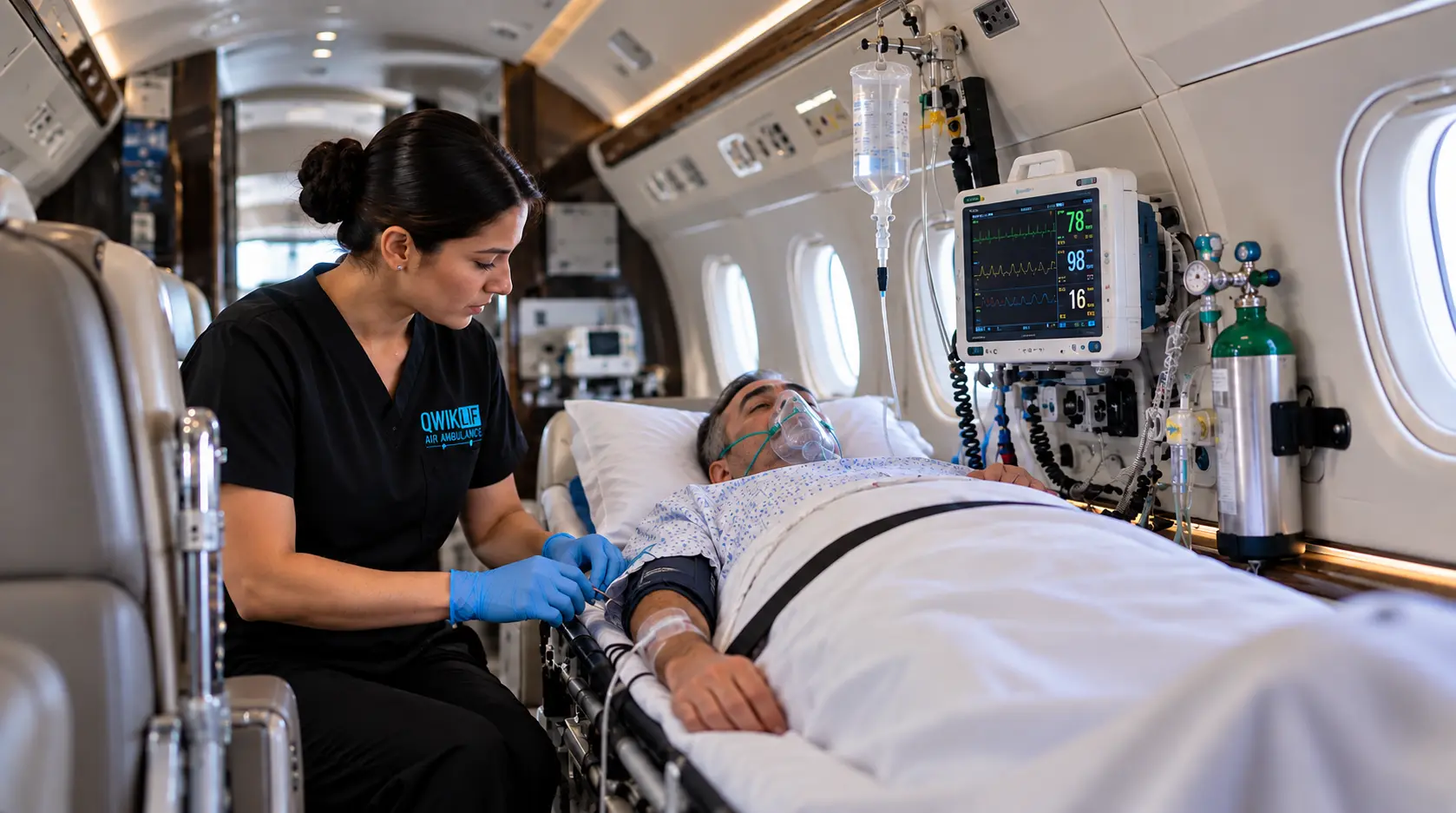
Flying is a normal part of modern travel. For most passengers, the journey involves checking in, boarding, sitting comfortably for several hours, and arriving at the destination.
For a patient requiring medical transportation, however, the journey is much more complex.
A medical air transport is planned around the patient's clinical needs rather than simply the destination and flight schedule. Medical assessment, monitoring, equipment, oxygen requirements, ground transportation, hospital coordination, and the patient's condition all become part of the journey.
The Journey Starts With the Patient, Not the Ticket
In ordinary air travel, the main questions are usually about the destination, date, and availability of a seat.
In air ambulance transportation, the starting point is different:
What does the patient medically require?
The medical team may review the patient's diagnosis, current condition, medications, mobility, oxygen requirements, recent procedures, and level of monitoring needed. This information helps determine the appropriate method of transportation and medical support.
The Cabin Environment Matters
An aircraft cabin is pressurized, but cabin pressure at cruising altitude is lower than pressure at sea level. This can reduce the amount of oxygen entering the bloodstream compared with conditions at sea level. Healthy passengers generally tolerate this change, but some patients with particular heart, lung, or blood conditions may require additional consideration or oxygen support.
There is also another consideration: changes in cabin pressure can cause trapped gases in the body to expand during ascent. This can be relevant for certain medical conditions and recent procedures.
This is one reason why medical flight planning cannot simply treat a patient like an ordinary passenger.
Medical Monitoring Continues During the Flight
A normal passenger can spend much of a flight reading, sleeping, or watching a movie without continuous medical observation.
A patient undergoing air medical transport may require ongoing monitoring according to their condition.
Depending on the patient's needs, medical equipment can include patient monitors, oxygen delivery systems, infusion equipment, ventilatory support, or other specialized equipment. WHO describes oxygen as an essential medicine and notes that safe oxygen therapy involves appropriate delivery systems and patient monitoring.
The purpose isn't simply to carry equipment. The medical team must know how and when it should be used.
A Medical Team Travels With the Patient
Another major difference is the presence of healthcare professionals appropriate to the patient's requirements.
Depending on the case, an air ambulance medical team may include doctors, nurses, paramedics, or other qualified personnel.
Their role goes beyond accompanying the patient. They monitor the patient's condition, provide appropriate medical care, respond to changes, and communicate important information during the transfer.
This is particularly important when transporting patients who cannot safely travel without medical supervision.
Ground Transportation Is Part of the Flight
An air ambulance journey rarely begins at the aircraft door.
A patient may need to travel:
Hospital → Ground ambulance → Airport → Aircraft → Destination airport → Ground ambulance → Receiving hospital
This is why bed-to-bed medical transfer requires coordination between multiple teams.
The aircraft may cover the longest physical distance, but the patient's journey includes several other stages before and after the flight.
Medical Repatriation Requires More Than Aviation Planning
For an international medical repatriation, additional arrangements may be required.
These can include:
- Medical documentation
- Airline or aviation requirements
- Receiving hospital coordination
- Ground ambulance arrangements
- Travel documentation
- Medical team planning
- Destination logistics
- Communication with the patient's family
WHO guidance on medical evacuation also highlights the importance of planning, appropriate medical staffing, equipment, and coordination before and during medical transport.
What Happens If the Patient's Condition Changes?
This is another important difference.
Ordinary air travel is primarily organized around transporting passengers according to a fixed itinerary. A medical air ambulance transfer must also account for the possibility that a patient's medical requirements can change.
The medical team monitors the patient and can respond according to the clinical situation and established transfer plan.
The exact response depends on the patient's condition, available resources, flight circumstances, and medical judgment.
It's Not Just a Flight—It's a Continuum of Care
The biggest difference between ordinary air travel and medical air transport is the purpose of the journey.
Ordinary air travel is primarily about moving a passenger from one destination to another.
Medical air transport is about moving a patient while supporting their medical needs throughout the journey.
From the initial assessment to the final hospital handover, every stage needs to work together.
The journey is:
Medical assessment → Transfer planning → Medical preparation → Ground transportation → Flight → Monitoring → Destination coordination → Hospital handover
That is what makes medical air transport fundamentally different from ordinary air travel.
For patients who require air ambulance services, international medical transportation, or medical repatriation, the flight is only one part of a much larger medical journey.