- December 4, 2025
- admin
- Comment: 0
- Dedicated Air Ambulance by Qwiklif
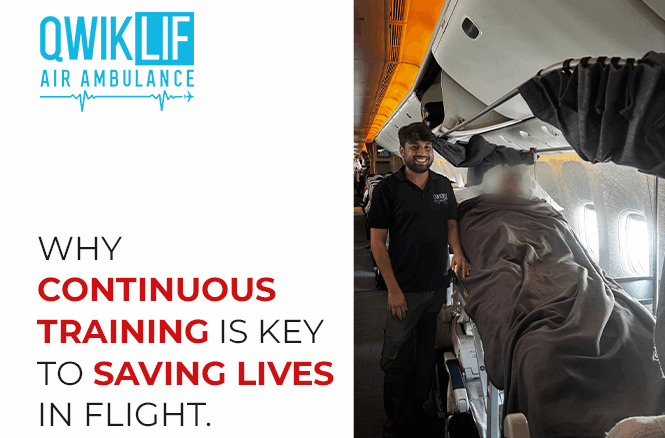
When lives hang in the balance thousands of feet above the ground, every second, every decision, and every skill matters. At Qwiklif Air Ambulance, our medical professionals operate in one of the most challenging environments in healthcare — a confined, fast-moving aircraft often functioning as an advanced flying ICU. To deliver safe, precise, and life-saving care in such conditions, one element becomes absolutely essential: continuous training.
Mastering the Complexity of Airborne Critical Care
In-flight medical care demands far more than standard emergency response expertise. The aircraft environment introduces additional variables such as limited space, altitude-related physiological changes, vibration, noise, and rapid patient transitions. Continuous training ensures that Qwiklif’s doctors, nurses, and paramedics are fully equipped to handle these complexities with confidence and accuracy.
Keeping Pace with Evolving Medical Protocols
Medical science is constantly advancing — new treatment guidelines, updated medication protocols, advanced monitoring tools, and innovative emergency techniques emerge regularly. Through ongoing education and simulation-based sessions, the Qwiklif Air Ambulance’s medical team stays aligned with the most current, evidence-based practices. This ensures every patient receives care that reflects the latest medical standards, not outdated procedures.
Enhancing Decision-Making Under Pressure
In the air, medical teams often face high-pressure situations where decisions must be made instantly. Continuous training strengthens critical thinking, sharpens situational awareness, and improves coordinated team responses. Whether managing cardiac emergencies, trauma cases, pediatric transfers, or ventilator-dependent patients, skilled decision-making is what keeps patients stable throughout the flight.
Building Seamless Crew Coordination
Air ambulance missions require excellent teamwork. Pilots, medical teams, ground coordinators, and receiving hospitals must function in perfect synchrony. Regular drills and joint training sessions help Qwiklif crews refine communication, streamline interventions, and eliminate hesitations during real emergencies. Seamless coordination is one of the strongest predictors of positive patient outcomes.
Preparing for Rare but High-Risk Scenarios
Some medical emergencies are uncommon — but when they occur midair, they require immediate, expert intervention. Through ongoing simulation training, Qwiklif Air Ambulance crews rehearse rare but critical scenarios such as sudden cardiac arrest, severe neonatal distress, inflight airway complications, or rapid cabin pressure changes. This readiness ensures no situation catches the team off guard.
Consistency Builds Confidence — For Patients and Families
Families entrust Qwiklif with their most precious loved ones. Knowing that every team member undergoes frequent upskilling, performance evaluations, and emergency simulations provides reassurance that the care delivered in flight is of the highest standard.
At Qwiklif Air Ambulance, continuous training isn’t just a routine — it’s a lifesaving commitment. It ensures that every mission is backed by skill, precision, and preparedness, giving patients the strongest chance of survival and stability from takeoff to touchdown.