
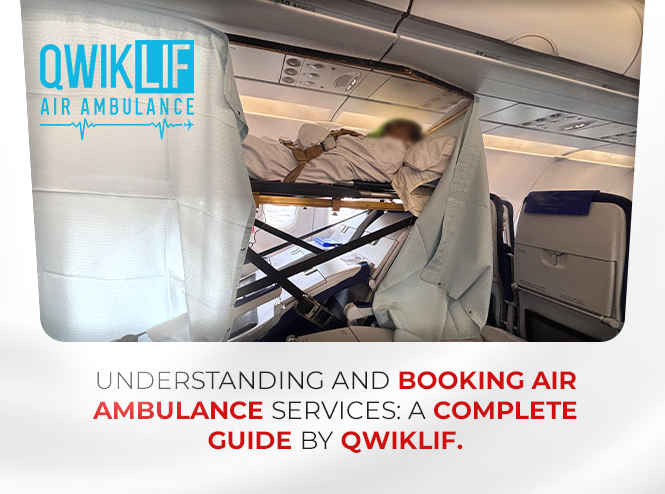
When urgent or specialized medical transportation is required, the choice of flight service plays a crucial role in patient safety and comfort. While both air ambulances and air charter flights offer speed and privacy, they are built for very different purposes. At Qwiklif Air Ambulance, we ensure families understand these differences so they can make informed decisions that prioritize care, safety, and efficiency.
Air Ambulances: Flying Intensive Care Units
An air ambulance is more than just a plane or helicopter—it’s a fully equipped flying ICU built to handle critical and non-critical medical cases with precision and care.
Here’s what sets air ambulances apart:
- Advanced Medical Equipment – Every Qwiklif aircraft is outfitted with life-saving tools such as ventilators, oxygen delivery systems, cardiac monitors, infusion pumps, and defibrillators.
- Expert Medical Teams – Onboard professionals include paramedics, flight nurses, and, when needed, physicians trained in emergency and critical care.
- Continuous Monitoring – From takeoff to landing, patients are monitored every second, ensuring their condition is stable and any changes are managed immediately.
- Custom Care – The interior layout is designed to allow seamless access to the patient, making in-flight care as efficient and comfortable as possible.
Air ambulances are ideal for:
- Critical patients needing constant medical supervision.
- Transfers between hospitals for advanced treatments, surgeries, or transplants.
- Long-distance or international travel where ground transport isn’t feasible.
Air Charter Flights: Speed and Comfort Without the Medical Edge
An air charter flight, while fast and private, is not a substitute for a medical air ambulance. These flights are typically designed for business or leisure travel, with no medical personnel or life-support equipment onboard.
Air charter flights may be an option for:
- Stable patients who do not require medical care during travel.
- Non-medical evacuations where comfort and speed are the main priorities.
However, using a standard charter for a patient who may need medical monitoring or in-flight interventions is risky and unsafe.
Why Choosing the Right Option Matters
Imagine transferring a cardiac patient on a regular air charter without a cardiac monitor or oxygen support onboard. Even a minor complication mid-flight could turn into a medical emergency. With Qwiklif Air Ambulance, the right equipment, personnel, and planning are always in place to keep patients safe.
Your choice shouldn’t just be about getting from point A to point B—it’s about ensuring the journey itself is as safe as the destination.
Supporting Search and Rescue Missions
In disaster zones, remote areas, or situations involving missing persons, drones excel at aerial surveillance. Equipped with thermal cameras and advanced sensors, they can quickly scan large areas, helping locate patients in distress faster than traditional ground searches. This capability allows Qwiklif teams to deploy air ambulances more efficiently and reach those in need without unnecessary delays.
Drones: A Complement, Not a Replacement
While drones bring innovation and speed to the table, it’s important to understand their role as a complementary tool—not a replacement for air ambulances. They cannot provide in-flight care or transport critically ill patients, but they enhance air medical operations by:
- Reducing response times
- Improving safety through better situational awareness
Enabling faster coordination between teams
Looking Ahead: The Future of Drone-Assisted Air Medical Care
As technology continues to advance, drones are expected to take on even more significant roles in air medical services. From autonomous navigation to AI-powered data analysis, the next generation of drones will make emergency care faster, safer, and more accessible, particularly in regions with challenging geography or limited infrastructure.
At Qwiklif Air Ambulance, we remain committed to integrating innovative tools like drone technology into our operations to deliver world-class air medical support—ensuring patients receive timely and efficient care, wherever they are.