
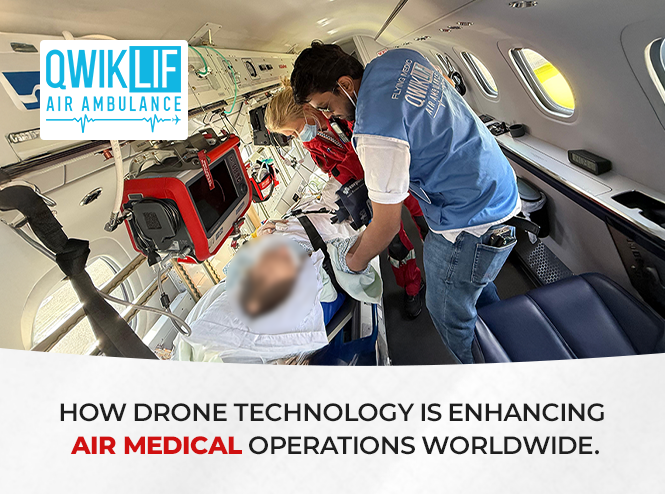
In recent years, drones have moved far beyond their original uses in photography and package delivery. Today, they are playing an increasingly important role in air medical operations, offering speed, accuracy, and support that can make the difference between life and death. At Qwiklif Air Ambulance, we recognize the potential of drone technology to complement our advanced air ambulance services, helping our teams respond faster, safer, and more efficiently.
Enhancing Emergency Scene Assessment
When an accident or disaster occurs, every second matters. Before an air ambulance lands, it’s critical to have accurate, real-time information about the scene.
Drones are now being deployed to:
- Capture aerial images and videos of accident or disaster sites.
- Identify obstacles or hazards that could affect safe landing.
- Provide live feeds to medical teams so they can prepare equipment and personnel accordingly.
This technology allows Qwiklif Air Ambulance crews to approach each mission with a clear plan, ensuring the safest and fastest possible patient retrieval.
Improving Coordination and Communication
Drones are also powerful tools for coordinating complex rescue operations. By transmitting live footage and data to command centers and ground teams, they enable seamless collaboration between:
- Air ambulance crews
- Ground ambulance teams
- Emergency medical staff at receiving hospitals
This enhanced coordination ensures that treatment can begin immediately upon landing, reducing critical delays and improving patient outcomes.
Streamlined Coordination with Hospitals and Ground Transport
When you book early, you give the Qwiklif coordination team ample time to arrange every detail of the journey, including:
- Securing landing and overflight permissions for international routes.
- Coordinating with receiving hospitals to prepare for immediate treatment upon arrival.
- Arranging ground ambulances at both departure and destination points.
- Completing all necessary paperwork and clearances without delays.
This level of advance preparation ensures a smoother, faster transfer—reducing stress for families and minimizing risks for the patient.
Delivering Medical Supplies When Every Second Counts
Another game-changing application of drones in air medical operations is rapid supply delivery. In remote or hard-to-reach locations, drones can quickly transport:
- Emergency medications
- Blood units for transfusions
- Small medical devices or life-saving kits
These deliveries can sustain patients until the air ambulance arrives, buying critical time in emergencies where every second counts.
Supporting Search and Rescue Missions
In disaster zones, remote areas, or situations involving missing persons, drones excel at aerial surveillance. Equipped with thermal cameras and advanced sensors, they can quickly scan large areas, helping locate patients in distress faster than traditional ground searches. This capability allows Qwiklif teams to deploy air ambulances more efficiently and reach those in need without unnecessary delays.
Drones: A Complement, Not a Replacement
While drones bring innovation and speed to the table, it’s important to understand their role as a complementary tool—not a replacement for air ambulances. They cannot provide in-flight care or transport critically ill patients, but they enhance air medical operations by:
- Reducing response times
- Improving safety through better situational awareness
Enabling faster coordination between teams
Looking Ahead: The Future of Drone-Assisted Air Medical Care
As technology continues to advance, drones are expected to take on even more significant roles in air medical services. From autonomous navigation to AI-powered data analysis, the next generation of drones will make emergency care faster, safer, and more accessible, particularly in regions with challenging geography or limited infrastructure.
At Qwiklif Air Ambulance, we remain committed to integrating innovative tools like drone technology into our operations to deliver world-class air medical support—ensuring patients receive timely and efficient care, wherever they are.