
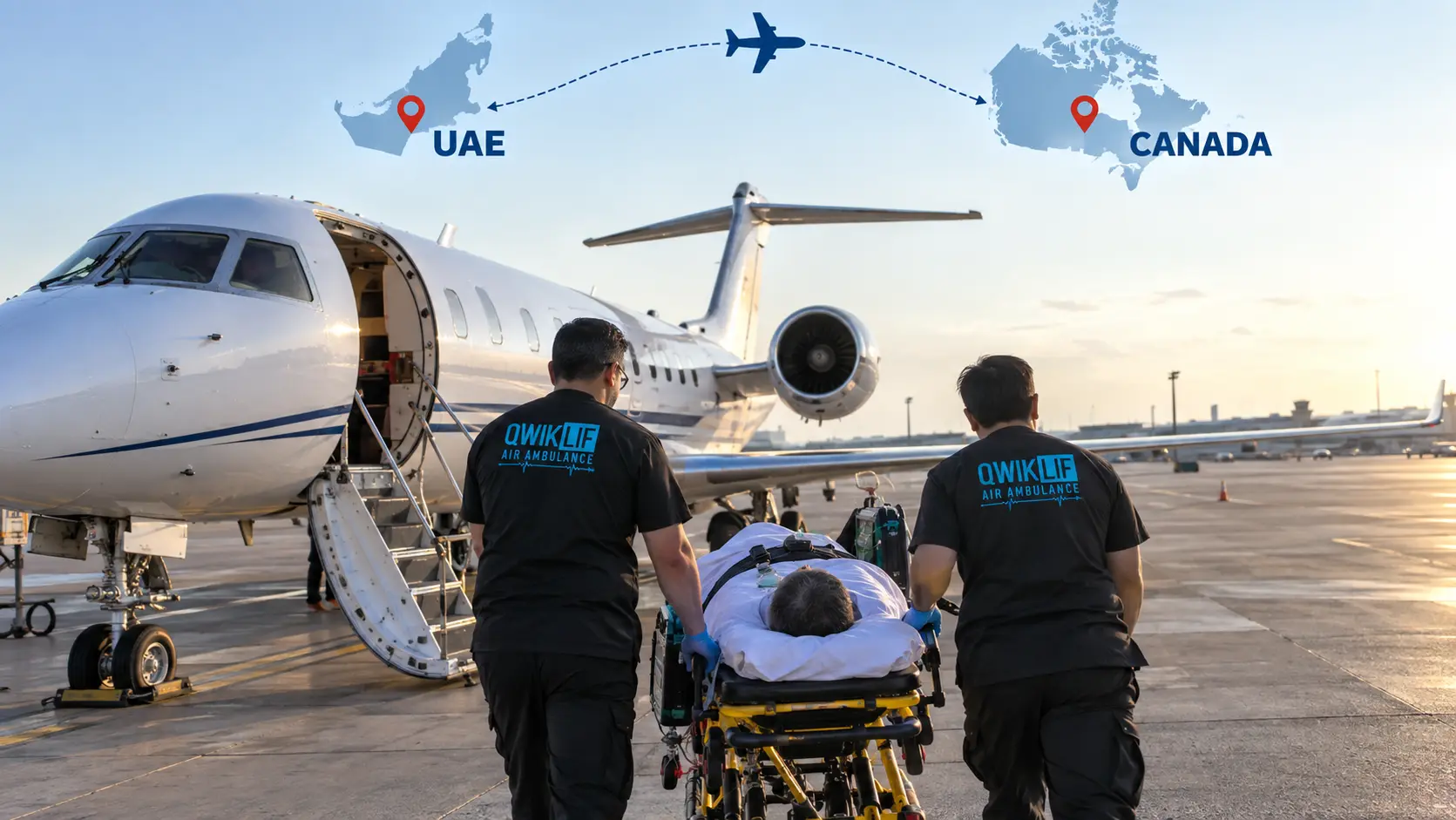
Long-distance medical travel can be challenging when a patient requires continuous medical supervision during the journey. For patients in the UAE who need to travel to Canada for further treatment, rehabilitation, specialist care, or repatriation, an air ambulance from UAE to Canada can provide a medically coordinated alternative to ordinary travel.
International air ambulance transportation is planned around the patient's condition, required medical support, flight distance, and receiving-hospital arrangements. The process can include ground ambulance transfers, medical assessment, flight coordination, in-flight care, and hospital-to-hospital handover.
When Is an Air Ambulance from UAE to Canada Considered?
An air ambulance UAE to Canada transfer may be considered when a patient is not suitable for regular commercial travel or requires medical support throughout a long-distance journey.
Patients may require air medical transportation because of:
- Serious injuries or trauma
- Stroke or neurological conditions
- Cardiac conditions
- Respiratory problems
- Patients requiring ventilator support
- Cancer-related medical transfers
- Post-surgical transportation
- Elderly patients requiring medical supervision
- Patients requiring specialist treatment in Canada
- Repatriation to Canada for continued care
The appropriate method of transportation depends on an individual medical assessment. In some situations, a patient who is stable enough to travel may be able to use a commercial flight with a qualified medical escort rather than a dedicated aircraft.
Medical Assessment Before the Flight
A long-distance medical transfer should begin with an assessment of the patient's current condition.
The medical coordination team may review:
- Recent medical reports
- Current diagnosis and treatment
- Vital signs and clinical stability
- Oxygen requirements
- Ventilator or other respiratory support
- Mobility and positioning requirements
- Medications and medical equipment
- Recent imaging and laboratory reports
- Receiving hospital requirements
This information helps determine whether the patient is fit to fly and what level of medical support may be required.
The assessment can also help determine whether a dedicated air ambulance, commercial stretcher service, or medical escort is more appropriate for the patient.
How the UAE to Canada Air Ambulance Process Works
An international air ambulance transfer involves several stages rather than simply booking an aircraft.
1. Medical Information Collection
The patient's medical documents are collected and reviewed by the medical team. The patient's condition, treatment requirements, and travel needs are evaluated.
2. Transport Planning
Based on the medical assessment, the appropriate mode of transportation is identified. Aircraft type, medical crew, equipment, ground ambulances, and other logistical requirements can then be planned.
3. Hospital Coordination
The receiving hospital in Canada should be contacted and the patient's admission or transfer arrangements confirmed before the journey.
4. Ground Ambulance in the UAE
The patient can be transported from the hospital, residence, or other approved location to the departure airport using an appropriately equipped ambulance.
5. In-Flight Medical Care
During a dedicated air ambulance flight, the patient can receive medical monitoring and treatment according to the clinical plan. Equipment may include patient monitors, ventilators, infusion pumps, oxygen systems, and other critical-care equipment when required.
6. Arrival in Canada
After landing, the patient can be transferred from the aircraft to a waiting ground ambulance. The ambulance then transports the patient to the receiving hospital.
7. Hospital Handover
The medical team provides the relevant clinical information to the receiving healthcare professionals, completing the bed-to-bed transfer.
Bed-to-Bed Air Ambulance from UAE to Canada
For international medical transportation, the flight is only one part of the journey.
A bed-to-bed air ambulance from UAE to Canada can coordinate the patient's movement from the initial healthcare facility through ground transportation, airport transfer, medical flight, arrival procedures, and transportation to the receiving hospital. This approach helps connect the different stages of the transfer and maintain continuity of medical information and care.
For a long-distance route such as the UAE to Canada, planning the complete journey is particularly important because the transfer involves multiple locations, healthcare teams, transportation arrangements, and international requirements.
Medical Equipment During the Flight
The equipment required depends on the patient's condition.
Depending on the clinical assessment, an air ambulance may be equipped with:
- ICU patient monitoring systems
- Ventilators
- Oxygen systems
- Infusion pumps
- Syringe pumps
- Defibrillation equipment
- Emergency medications
- Specialized critical-care equipment
The medical team and equipment should be selected according to the patient's individual requirements rather than using the same configuration for every transfer.
Dedicated Air Ambulance or Commercial Medical Escort?
Not every patient travelling from the UAE to Canada necessarily requires a dedicated air ambulance.
For patients who are medically stable and suitable for commercial aviation, a medical escort or commercial stretcher transfer may sometimes be considered. Patients with higher medical needs may require a dedicated aircraft configured for medical transportation.
The decision depends on factors such as:
- Patient stability
- Required medical equipment
- Oxygen or ventilator dependency
- Mobility
- Duration and complexity of the journey
- Medical team's recommendation
- Airline requirements
- Receiving hospital arrangements
A proper medical assessment should therefore be completed before deciding on the transportation method. UAE healthcare procurement guidance also describes both dedicated air ambulance and commercial medical escort options depending on patient suitability.
Planning an International Medical Transfer to Canada
A UAE to Canada medical transfer can involve several logistical considerations, including:
Medical clearance: The patient's current condition and fitness for air travel need to be assessed.
Receiving hospital: The destination facility should be prepared to receive the patient and continue the required treatment.
Ground transportation: Suitable ambulances may be required at both ends of the journey.
Medical documentation: Relevant reports, treatment details, medication information, and other clinical documents should travel with the patient.
Flight arrangements: Aircraft and medical staffing need to match the patient's clinical requirements and the route.
International coordination: Airport, immigration, medical, and other travel requirements may need to be addressed before departure.
Why Bed-to-Bed Coordination Matters
A medical transfer does not end when the aircraft lands. The patient still needs to reach the receiving hospital safely.
For this reason, bed-to-bed planning connects the major stages of the journey:
UAE Hospital → Ground Ambulance → Airport → Air Ambulance → Canadian Airport → Ground Ambulance → Receiving Hospital
This coordinated approach can reduce gaps between transportation stages and helps ensure that medical information and responsibility are communicated between the teams involved.
Air Ambulance from UAE to Canada with QwikLif
QwikLif Air Ambulance coordinates international patient transportation based on the patient's medical requirements and travel circumstances.
Services may include dedicated air ambulance transportation, commercial medical escort, stretcher transfers, ground ambulance coordination, and bed-to-bed medical transport.
For patients travelling from the UAE to Canada, the transport plan can be developed around the patient's clinical condition, required equipment, medical team, departure arrangements, and receiving-hospital coordination.
Conclusion
An air ambulance from UAE to Canada can provide a medically supervised option for patients who require additional support during a long-distance international journey. Successful medical transportation involves much more than arranging an aircraft. It requires clinical assessment, appropriate medical staffing, equipment planning, ground transportation, hospital coordination, and a structured handover at the destination.
For families and healthcare providers arranging a UAE to Canada air ambulance, the first step is to assess the patient's condition and determine which form of medical transportation is appropriate. From there, the journey can be planned around the patient's individual medical and logistical requirements.