
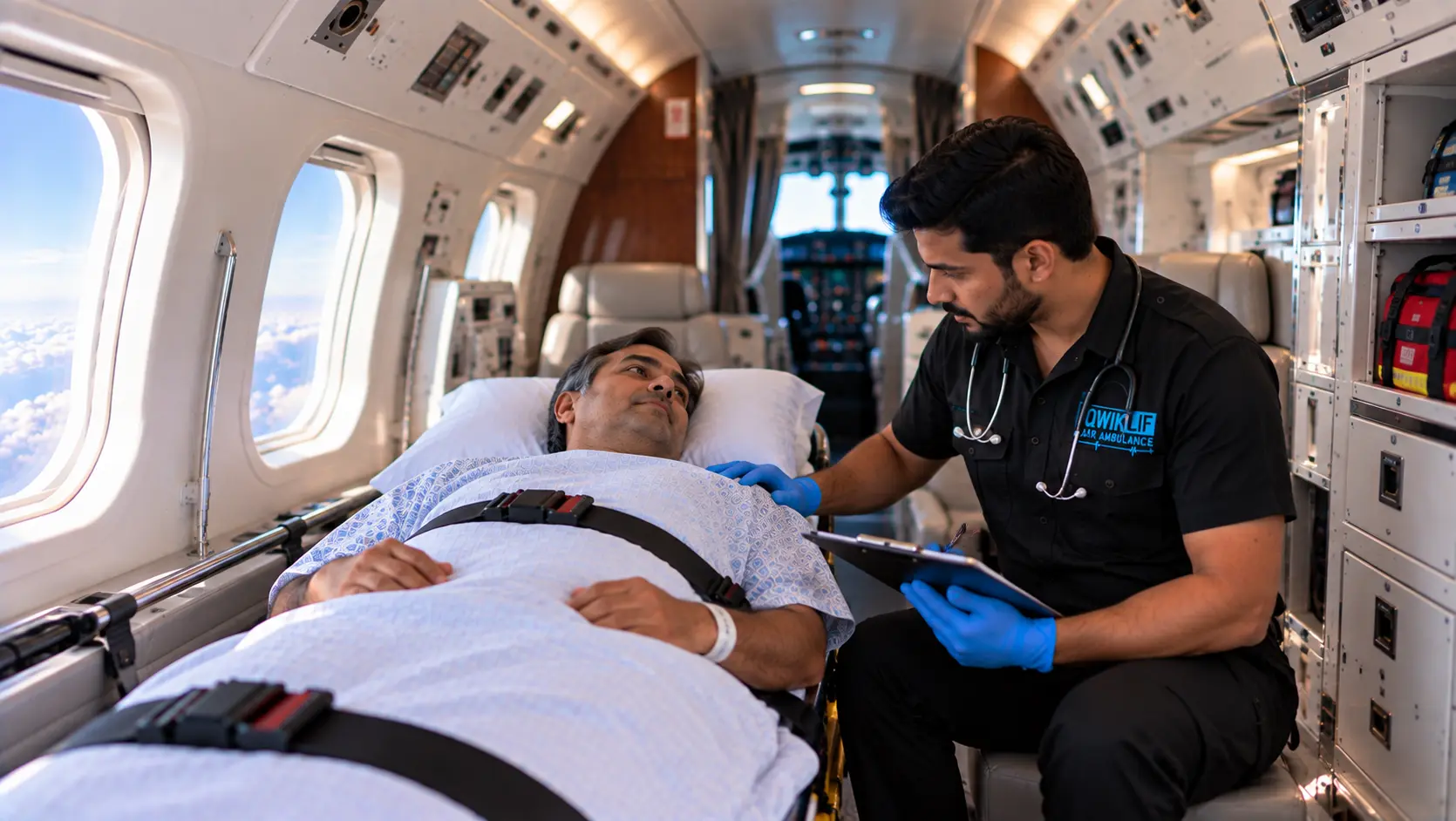
Serious injuries may require treatment at a specialist hospital located far from the patient's current location. In such situations, an air ambulance for trauma patients can provide medically supervised transportation when road travel is unsuitable or when specialist treatment is available in another city or country.
An air medical transfer is planned according to the patient's condition, required medical support, travel distance, destination hospital, and available aircraft and medical team.
When Is Air Ambulance Transport Considered for Trauma Patients?
Trauma can result from road accidents, falls, workplace injuries, sports incidents, and other serious events. An air ambulance for trauma patient transfer may be considered when:
- Specialist trauma or neurological care is required.
- The destination hospital is a significant distance away.
- A long road journey may be unsuitable for the patient.
- Medical monitoring or treatment is required during transportation.
- The patient needs to return to another country for continued treatment.
- A specialist medical facility cannot be reached conveniently by road.
The choice between road and air transportation depends on the patient's clinical condition and the assessment of the treating and transfer teams.
Medical Assessment Before an Air Transfer
Before arranging air medical transport, the patient's condition is reviewed to determine whether the journey is medically appropriate and what level of support may be required.
The assessment may include:
- Severity and type of injuries
- Current vital signs and stability
- Airway and breathing requirements
- Neurological condition
- Oxygen or ventilator requirements
- Medication and infusion needs
- Recent surgery or procedures
- Required medical equipment and personnel
Patients with serious or unstable injuries may need treatment and stabilisation before transportation. The timing of the transfer should be determined by the treating medical team.
Medical Care During an Air Ambulance Transfer
Depending on the patient's condition, an air ambulance service may provide:
Continuous Monitoring
Medical monitors can be used to observe vital parameters throughout the journey.
Respiratory Support
Oxygen therapy or mechanical ventilation can be arranged for patients who require breathing support.
Medication and Infusion Support
Required medications, fluids, and infusion equipment can be prepared according to the patient's treatment plan.
Qualified Medical Personnel
Doctors, nurses, paramedics, or other appropriately trained professionals may accompany the patient depending on the required level of care.
Safe Patient Handling
Stretchers, immobilisation equipment, and appropriate transfer procedures can help support patients with fractures, spinal injuries, or post-operative conditions.
How Is a Trauma Patient Transfer Coordinated?
A hospital-to-hospital transfer involves several stages:
- Medical review: Patient reports and current medical information are assessed.
- Hospital coordination: The receiving hospital's acceptance and treatment capability are confirmed.
- Transport planning: The appropriate aircraft, route, medical team, and equipment are selected.
- Ground ambulance arrangements: Transfers between hospitals and airports are organised.
- Documentation: Medical clearances, travel documents, and other required approvals are completed.
- Patient transfer: The patient travels under the agreed medical plan with appropriate supervision.
For an international patient transfer, additional arrangements may be required for airline approvals, flight permissions, travel formalities, and ground transportation.
Dedicated Air Ambulance or Commercial Airline Transfer?
The appropriate transportation method depends on the patient's condition and medical requirements.
A dedicated air ambulance may be suitable when the patient requires specialised onboard equipment, intensive medical support, or an aircraft configured specifically for medical transportation.
A commercial airline medical transfer may be considered for selected patients who are medically fit to travel under the airline's requirements. Depending on the case, this may involve a medical escort or commercial stretcher service.
Air Ambulance for Complex Trauma Cases
Patients with head injuries, spinal injuries, multiple fractures, respiratory problems, or recent surgery may require additional planning.
Depending on the case, the transfer may require:
- Advanced patient monitoring
- Mechanical ventilation
- Oxygen support
- Infusion pumps
- Emergency medical equipment
- Medication management
- Immobilisation
- Specialist medical personnel
The equipment and level of care are selected according to the patient's individual requirements.
How QwikLif Supports Trauma Patient Transfers
QwikLif Air Ambulance coordinates international air ambulance services, medical transportation, and hospital-to-hospital transfers.
Our coordination can include:
- Reviewing medical reports
- Communicating with sending and receiving hospitals
- Assessing suitable air medical transport options
- Arranging medical personnel and equipment
- Coordinating ground ambulance services
- Supporting medical documentation and travel requirements
Each trauma patient transfer is assessed individually based on medical needs, destination, aircraft availability, and operational requirements.
Frequently Asked Questions
Can trauma patients travel by air ambulance?
Some trauma patients can be transported by air when their condition has been medically assessed and the required support is available.
Can a ventilated trauma patient travel by air?
Yes, selected ventilated patients may be transported when suitable respiratory equipment, medical personnel, and medical clearance are available.
Can trauma patients be transferred internationally?
Yes. International medical evacuation and trauma patient transfers can be arranged for medically suitable patients, subject to hospital acceptance, medical clearance, and operational requirements.
What information is needed for an air ambulance?
Medical reports, current clinical condition, treating hospital details, destination, treatment history, and information about required medical support are generally needed for an initial assessment.
Conclusion
An air ambulance for trauma patients can provide a medically supervised transportation option when a patient needs to reach a distant specialist hospital or continue treatment in another country. Medical assessment, appropriate equipment, qualified personnel, receiving hospital coordination, and ground transportation are important parts of the transfer.
QwikLif Air Ambulance supports air medical transport, international patient transfer, medical evacuation, and hospital-to-hospital transfers based on each patient's medical and logistical requirements.