
- November 7, 2025
- admin
- Comment: 0
- Dedicated Air Ambulance by Qwiklif
When every second counts, few services can match the lifesaving speed and precision of an air ambulance. Yet, one of the most common questions people ask is: Why is air medical transport so expensive? To understand this, we must look at the economics of medical aviation — a complex ecosystem that blends advanced healthcare, aviation technology, and critical logistics into one mission: saving lives.
A Fusion of Medicine and Aviation
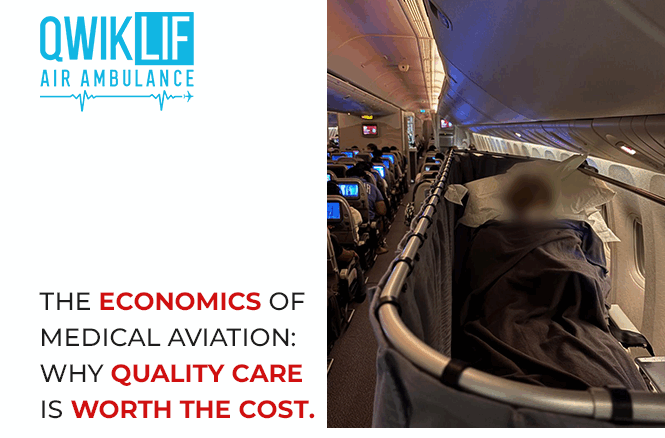
Unlike commercial flights, an air ambulance isn’t just a mode of transport — it’s a flying intensive care unit (ICU). Every aircraft is equipped with advanced life support systems, ventilators, cardiac monitors, infusion pumps, and other critical-care equipment. Add to that a highly trained medical crew, including flight doctors, paramedics, and nurses, and you have a mobile hospital in the sky.
Maintaining such an operation involves stringent aviation regulations, 24/7 readiness, and high maintenance standards. Each flight undergoes meticulous planning — from route clearance to hospital coordination — ensuring patients receive uninterrupted care from takeoff to touchdown.
Breaking Down the Cost
The cost of air medical transport is influenced by several vital components:
- Aircraft operations: Fuel, pilot salaries, and regular aircraft maintenance contribute significantly to expenses.
- Medical staffing: Specialized teams undergo continuous training to handle emergencies in high-pressure, low-gravity conditions.
- Equipment & technology: Keeping ICU-grade medical gear in optimal condition ensures safety and reliability mid-air.
- Licensing and insurance: Air ambulances operate under strict aviation and healthcare laws, requiring comprehensive coverage and compliance.
- Standby readiness: A fleet and crew must remain ready around the clock, even when not flying, to respond at a moment’s notice.
Each of these elements adds to the overall cost, but also ensures that when an emergency strikes, no time or life is lost due to unpreparedness.
The True Value: Time, Safety, and Survival
When you or a loved one faces a medical emergency, cost becomes secondary to time. Studies consistently show that rapid evacuation and immediate access to advanced care can drastically improve survival rates. Whether it’s a heart attack in a remote area or an accident abroad, Qwiklif’s swift response ensures patients reach the right medical facility in the shortest possible time.
Think of it not as a service expense, but as an investment in survival. The value of a life saved, the peace of mind for families, and the continuity of expert medical care mid-air far outweigh the operational costs involved.
Quality That Justifies the Price
At Qwiklif, every mission is guided by one principle — quality care without compromise. From state-of-the-art aircraft to compassionate, skilled crews, every element is designed to deliver excellence, even in the most challenging situations.
In the end, the economics of medical aviation isn’t about the cost of a flight — it’s about the value of a life saved. And that’s a price you can never truly put a number on.